
“I’ve gained a deeper understanding of the challenges faced by older persons, especially those without family support and living alone, and that insight has changed the way I view aging and older persons,” said Rhea M. Tagros.
Ate Rhea, 40, resides in Barangay Ipil-ipil, Catarman, Northern Samar, with her common-law husband. She is currently employed as a Care Worker at the Pagkalinga Center in Barangay Polangi, Catarman. Commonly known as the Senior Citizens Day Care Center, this facility provides supervised care and engaging activities for older persons, particularly those showing early signs of dementia.
Officially opened in April 28, 2025, the center operates from 8:00 AM to 5:00 PM and regularly serves seven older persons, although there are times when as many as sixteen clients attend. A weekly schedule of activities is in place and is repeated throughout the month.
 Before joining the Coalition of Services of the Elderly, Inc. (COSE), Ate Rhea worked for two years as a Document Processor at Brightmind Business Development Services, also based in Northern Samar. Motivated by the desire to gain new experiences and improve her career prospects, including better compensation and benefits, she applied to COSE, where she found the growth and support she had been seeking.
“I initially thought that my job at COSE would simply provide a stable income, but fortunately, it has given me so much more. The real reward lies in the happiness and deep sense of fulfillment I feel every day while working with and caring for older persons at the Pagkalinga Center.”
Ate Rhea used to be a shy and reserved person, but through her regular interactions with fellow care workers and older persons, she has become increasingly confident, engaging, and actively involved in her work. “This experience has enriched me personally and professionally,” Ate Rhea said.
She added, “My understanding of older persons and the aging process has deepened over time, especially when it comes to those who have no one to care for them or those living alone. I used to think they could manage on their own, but through my work and observations, I’ve come to realize that they truly need consistent care, attention, and compassion from people around them.”
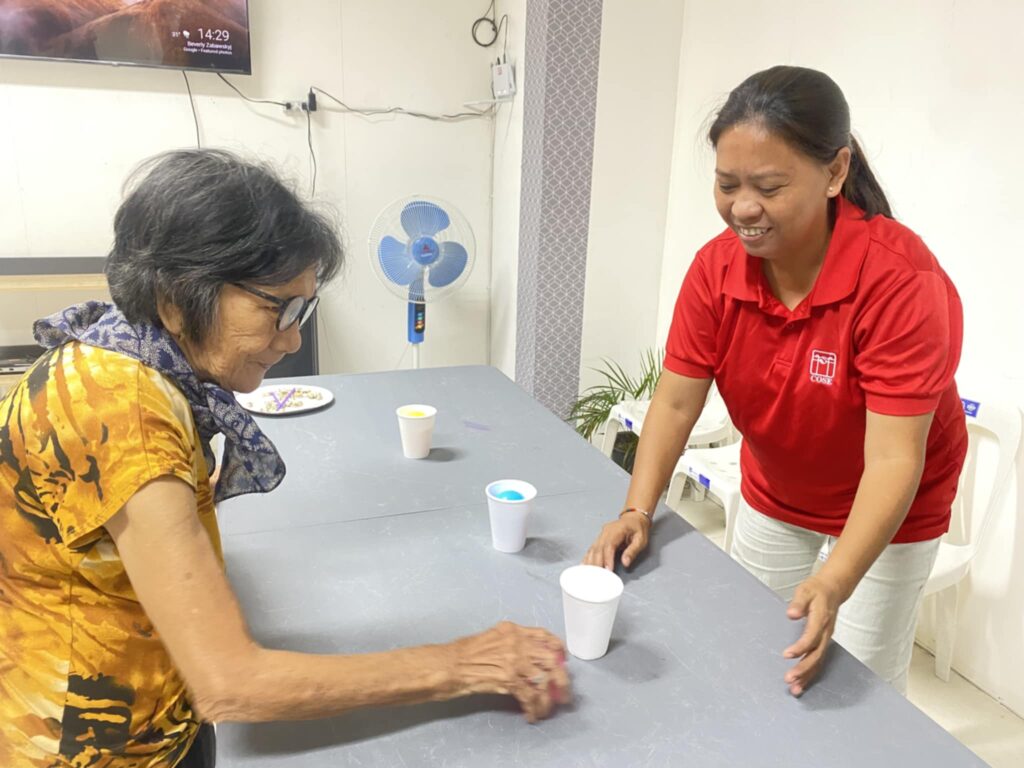
Ate Rhea facilitates various activities at the Pagkalinga Center, including physical exercises, cognitive games, and simple daily tasks such as assisting clients with walking, sitting, getting up, or going to the bathroom.
The older persons actively participate and appear to genuinely enjoy the activities. “At first, I worried they might get bored, especially when we were still figuring things out. But over time, as we became more familiar and confident in what we were doing, it became enjoyable for everyone, even us, the staff,” Ate Rhea happily shared.
One of the ongoing challenges Ate Rhea and her fellow care workers face is finding new and engaging activities for the older persons at the Center. She sometimes worries that the repetitive nature of the schedule might eventually lead to boredom among the clients.
Despite this, Ate Rhea remains highly motivated to learn and apply new strategies to improve the quality of care. Her goal is to ensure that every older person at the Pagkalinga Center feels safe, secure, and genuinely cared for. She is especially committed to older persons like Nanay Lucila, who is often left unattended by her family. Caring for her gives Ate Rhea a deep sense of fulfillment, knowing that her presence and care bring comfort and joy.
To support Ate Rhea and her fellow care workers, COSE, through the Regional Programme for Elderly in Asia, supported by the Federal Ministry for Economic Cooperation and Development (BMZ) and Caritas Germany, provides training and capacity-building opportunities. Ate Rhea has completed a Training on Elderly Care in Tacloban City, Leyte, and even participated in a field exposure program in South Korea, which broadened her knowledge and deepened her commitment to quality care for older persons.
“One of the most important lessons I’ve learned from working with older persons—especially those with high care needs- is that they deeply require attention, care, and support, particularly from their families. Sadly, that support isn’t always there,” Ate Rhea said. “In some cases, the Pagkalinga Center fills that gap.”
“This experience has opened my eyes and reminded me that my own family also deserves my time and care, too, which sometimes I failed to provide. I want to do my best to make them feel seen, supported, and valued,” Ate Rhea shared.
She added, “I also hope that our team at the Pagkalinga Center continues to grow stronger and more united, so we can provide even better and higher-quality care for our clients.”
For Ate Rhea, the Pagkalinga Center is more than just a workplace; it has become her newfound family and the place where she discovered a deeper sense of purpose. “As long as Pagkalinga needs me,” she said, “I’m more than willing to stay.”
Written by Louriel John Siervo