
“As a Mobile Health Care Worker, I feel a different kind of happiness. The smiling faces of older persons welcoming me during each visit fill my heart with joy. Working with older persons is truly a blessing.”
My name is Victoria C. Tejano, but my family and friends call me Toyang. I am a proud mother of five – four daughters and one son. My common-law husband and I live in Vigaan, Sipocot, Camarines Sur. At 63, I can say I’ve been through a lot. Life hasn’t always been easy, but it has been meaningful.
From 1982 to 1994, I served as a Community Volunteer Health Worker (CVHW). Around 1989, I also worked as a Local Community Organizer for the Philippine Rural Reconstruction Movement (PRRM) in our Municipality. In 1994, I was elected as a Barangay Councilor, receiving a monthly honorarium of just P600. After nine years of being a Barangay Councilor, I became Barangay Captain. Due to term extensions, I held that position for 13 years, from 2003 to 2017.
When my term as Barangay Captain ended, I returned to farming. At that time, my children were already all grown up and had started working away from our village. Sometimes, I felt like something was missing in my life. I even asked myself, “Is this the end of my life’s mission? I missed working with the community. This feeling became even stronger during the COVID-19 pandemic when I couldn’t leave our village.
Until one day, while attending a meeting of the Barangay Association of Senior Citizens Affairs (BASCA), our President announced that the Coalition of Services of the Elderly, Inc. (COSE) needed a Mobile Health Care Worker (MHCW) for the Municipality of Sipocot. The BASCA Secretary encouraged me to apply, so I did.
Fortunately, I was hired. On September 1, 2023, I officially began my role as an MHCW, responsible for serving the 23 barangays of Sipocot. After completing a three-day Homecare Volunteers Training and familiarizing myself with COSE’s guidelines and the responsibilities of an MHCW, I immediately started visiting the BASCA Presidents in each barangay to identify older persons who are bedridden and with disabilities, as they are the priority clients of the MHCW.
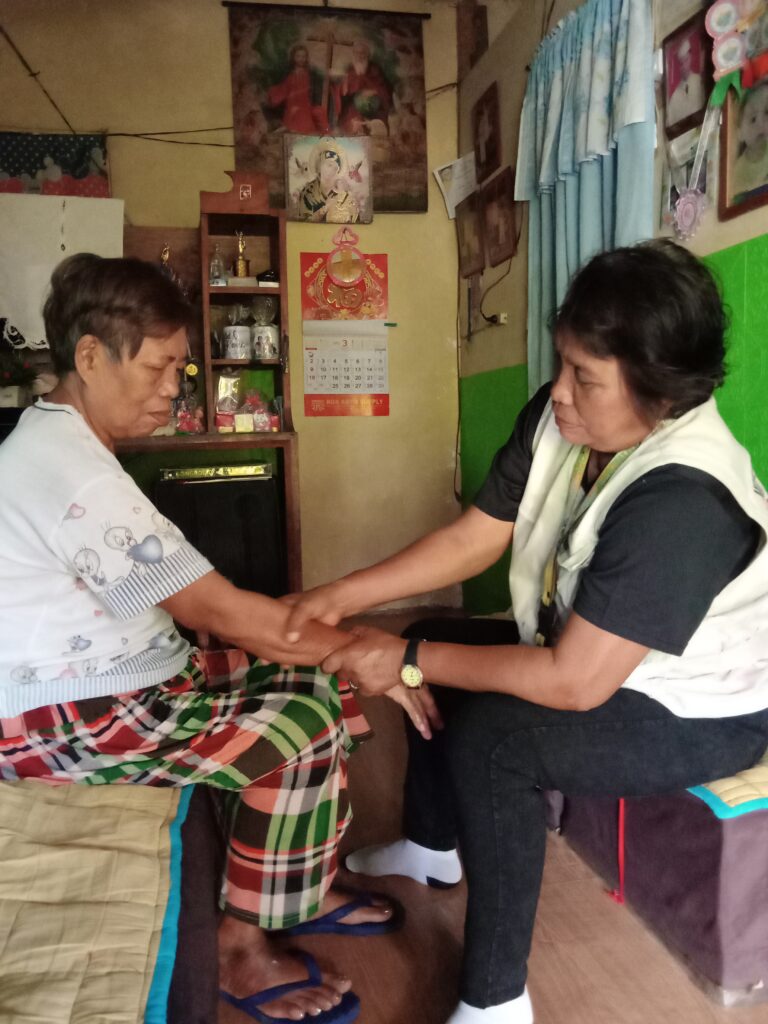 In the Municipality of Sipocot, 98 older persons have been identified as priority clients. Of this number, 25 to 30 are regularly visited each month. During these visits, I provide basic health care services such as taking and monitoring vital signs. I alsoprovide personal care services, including assisting with bathing, nail cutting, and hair trimming. Additionally, I spend time listening to their stories, cooking meals, and helping with various household chores.
Being a Mobile Health Care Worker is both challenging and fulfilling. At times, it’s physically and emotionally draining, especially during my first few months as an MHCW. The first visit was particularly hard. I saw older persons who hadn’t bathed for days, were hungry, neglected, and in tears as they shared how difficult life had become. I wanted to provide them with their needs, but I knew I had limitations.
Walking on muddy roads and long distances became part of what I do. But despite these challenges, the visits still have to be done because the older persons are waiting. Sometimes, a simple “kumusta (how are you), a gentle touch, or a warm hug brings them to tears or brightens their day. In those moments, I felt that I had become a small source of hope for them.
The support from the project has been invaluable. The material things, such as uniforms, bags, helmets, motorcycles, raincoats, boots, as well as the capacity development activities like training and quarterly meetings, have greatly helped me improve my knowledge and skills in the work that I do.
I know that neither the project nor I can provide everything the older persons need. Because of this, I did everything I could. I looked for good Samaritans who were willing to help. Fortunately, many responded. Some concerned citizens donated wheelchairs, canes, hygiene kits, used clothes and bedding, medicines, blood sugar test kits, and more. These gifts were warmly welcomed and appreciated by the older persons in need.
I can say that my perception of and attitude toward older persons have improved. Working as an MHCW has taught me humility. As an older person myself, I’ve realized that beyond the traditional mano gesture, what older persons truly need is quality time, genuine love and care, and support from family, or at the very least, someone who checks on them.
The situation of older persons in our community inspired me to continue my work. It is a blessing that our Municipal Mayor has expressed support for continuing this initiative even after the COSE project ends, with plans for the Municipality to adopt Mobile Health Care Services to ensure continued assistance to older persons, especially those in need.
Written by Victoria C. Tejano